There's Treasure Inside: A Hunter's Guide to Jon Collins-Black's 5 Boxes
What we know, what hunters are doing wrong, and how to organize a search that actually has a chance.
1. The hunt at a glance
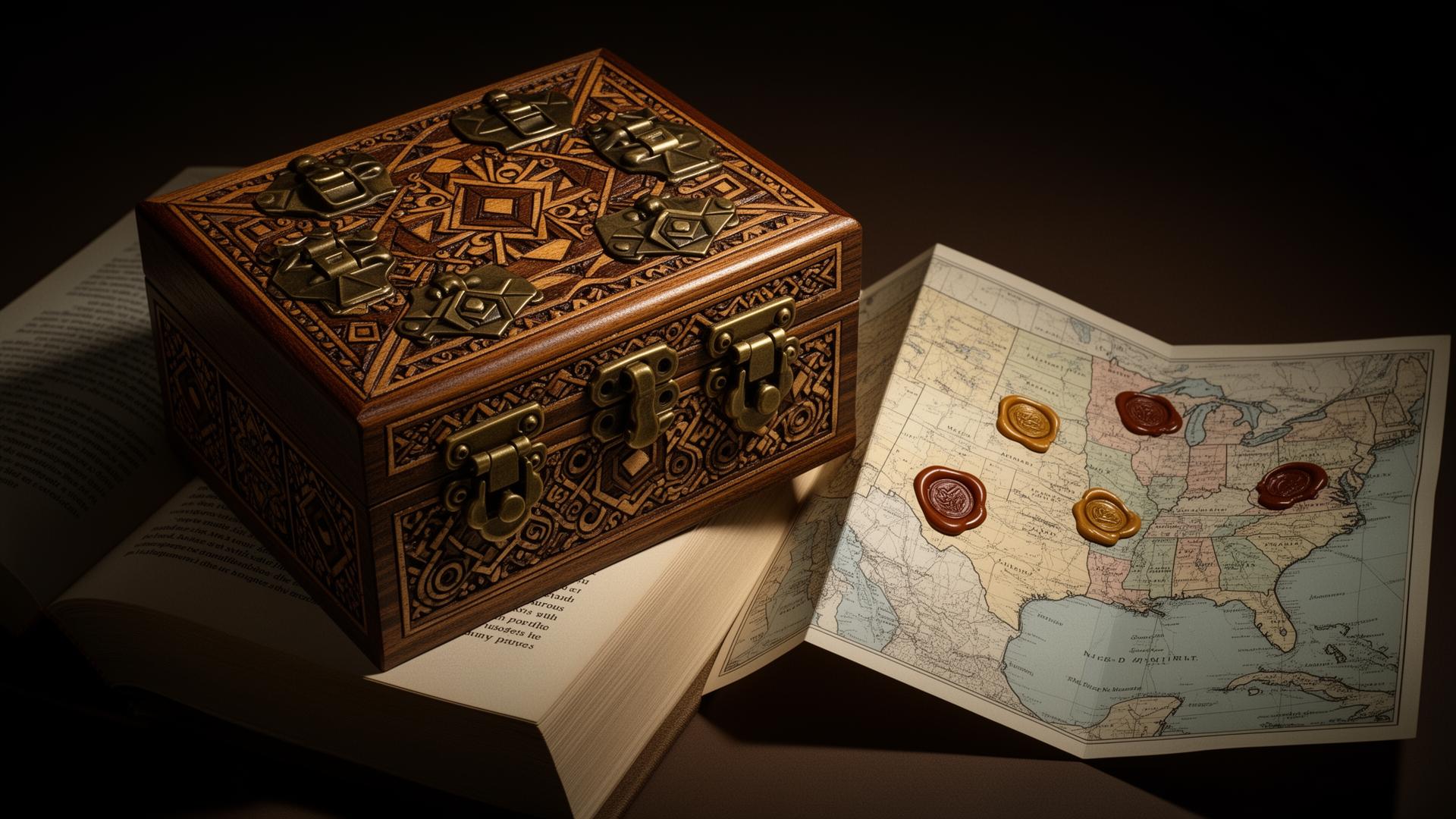
There's Treasure Inside by Jon Collins-Black (JCB) launched on November 12, 2024, with an eBook following in mid-December. Inside the book are clues to five separate treasure boxes hidden across the United States, with a combined value publicly reported at over $2 million. No more than one box is hidden in any single state, and as of this writing none of them have been recovered.
The boxes themselves are puzzle boxes designed and crafted by metalsmith Seth Gould, tucked inside protective cases. Each of the four smaller boxes also contains a commemorative coin Gould designed for that specific box.
2. The five boxes
The community has settled on names for each box based on how its clues sit in the book. One is "the big one"; the other four have a chapter dedicated to them in Part Two.
- The Lion's Share Box. The largest treasure. Clues are scattered across the entire book — and possibly into JCB's children's book Our Unbreakable Thread. This is the one most hunters chase, and it's the hardest to scope.
- The Forrest Fenn Box. Tied to JCB's love of the Fenn hunt. It contains items he bought at the Heritage auction of Fenn's recovered chest — a Tairona Colombia necklace, gold beads, a gold nugget, and the olive jar that holds Fenn's autobiography.
- The Pokémon Box. Themed around its chapter; the community has long-running threads on what's being signaled inside the chapter (including the "alternative take on RPO" line of thinking).
- The Past & Future Box. Home of the cryptogram and the word search — the most-discussed puzzles in the entire book. Many searchers consider the cryptogram's primary message essentially decoded; the word search is still being argued over.
- The Appalachian Footpath Box. Strongly suggests the Appalachian region; community state theories have narrowed the candidates considerably.
3. Confirmed rules vs community theory
Build on what JCB has actually said — in the book, on his website, and in interviews. Treat everything else as theory, no matter how confidently it's posted.
Confirmed by JCB:
- Boxes are hidden, not buried. No digging, no shovel, no metal detector required.
- None are on or across private property.
- All in "safe" places. You should never need to wade through high water or wander far from a public trail.
- No box is hidden more than three miles from a road, and most are reachable in well under two hours of walking from where you'd park.
- Don't search with snow on the ground.
- Mother Nature is in play — JCB has acknowledged a box could be lost to weather or erosion.
- You don't need to be a genius. JCB is explicit that no grand cipher is required to find a box.
- The four smaller boxes' clues live primarily in their dedicated chapters in Part Two; the Lion's Share clues can be anywhere in the book.
Active community theory (treat as theory, not fact):
- The Olympic-rings page as a hint to the general regions of the five boxes.
- The underlined letters / calendar pattern as a Lion's Share solve aid.
- Items on the shelf in JCB's filmed interviews as deliberate visual clues.
- Whether New York can be ruled out as a hide state.
4. Reading the book like a hunter
JCB's own advice is simple and worth following:
- Read it through once thoughtfully, then again. Let it marinate between passes.
- Jot down anything that makes your "spidey sense tingle" — even if you can't say why.
- If a story or detail interests you, investigate further. That curiosity is often the intended hook.
- Don't skip anything outside the safety section — clues for the Lion's Share could be hiding anywhere.
- Beware confirmation bias. JCB has called this out by name. Once you fall in love with a theory, every page starts to "agree" with you.
- Value your own thinking over forum consensus. Forums are good for vibes; they are bad for facts.
5. The well-known puzzles
A handful of puzzles have absorbed most of the community's attention. Knowing where they stand keeps you from re-solving what's already been chewed over and from anchoring on interpretations that are still very much in flux.
- Past & Future cryptogram. Widely considered to have a primary message most searchers agree on. What the message points to in the world is still open.
- Past & Future word search. "Count eleven," 11×11 grid theories, and rail-cipher reads are all in play. No consensus.
- Olympic rings. Possible regional hint to where the five boxes sit. Suggestive, not confirmed.
- Calendar / underlined letters. A Lion's Share lead being worked extensively on Mysterious Writings.
- Shelf items in interviews. Possibly props chosen as quiet clues. Possibly just JCB's bookshelf. Don't bet a trip on them.
Treat any "solved" puzzle as a candidate until a box is in someone's hands. JCB has said that when one box is found, several of the others will likely fall quickly — which means today's confident community solve might be slightly off in a way nobody can prove yet.
6. Picking a state and a search area
Once you've committed to chasing a particular box, the box's rules do most of the work of narrowing your map:
- Drop your candidate state into a topo + satellite view.
- Eliminate everything more than ~3 miles from a road.
- Eliminate private parcels — county GIS layers are your friend here.
- Eliminate anything that would require crossing high water or wandering off a public trail.
- Look for places that fit the chapter's imagery: a footpath for the Appalachian Box, a "past and future" location with a strong dual identity, etc.
What's left is small enough to actually scout. JCB has encouraged a grid searchof the believed area once you're there — check every nook and cranny, not just the obvious feature.
7. Planning the BOTG trip
The TTI hunt is unusually friendly to BOTG planning, by design. JCB has worked hard to keep the boxes within a short, safe walk of public access. Honor that:
- No snow on the ground — this is JCB's explicit guidance, not a suggestion.
- Pick a weather window. Most candidate areas are seasonal even when they're not technically dangerous.
- Plan to grid-search a small area, not race to a single point. Bring time, not just enthusiasm.
- Print your trip plan. Cell service drops; paper doesn't.
- Tell someone where you'll be and when you'll be back, even for a "two-hour walk."
8. A Treasure Notes workflow for TTI
Because TTI is really five hunts in one, the single most useful structural decision is to keep them separate. Here's how a serious TTI searcher tends to set up:
- One Hunt per box — Lion's Share, Forrest Fenn, Pokémon, Past & Future, Appalachian Footpath. Theories don't bleed across boxes that way.
- Tag clues by chapter and page. When JCB says clues for the smaller boxes live "primarily" in their chapters, your tags should reflect that scope.
- Clip from the web with the extension. Mysterious Writings posts, the Treasure Inside Substack, Reddit threads, JCB interviews — right-click and save them straight into the right Hunt.
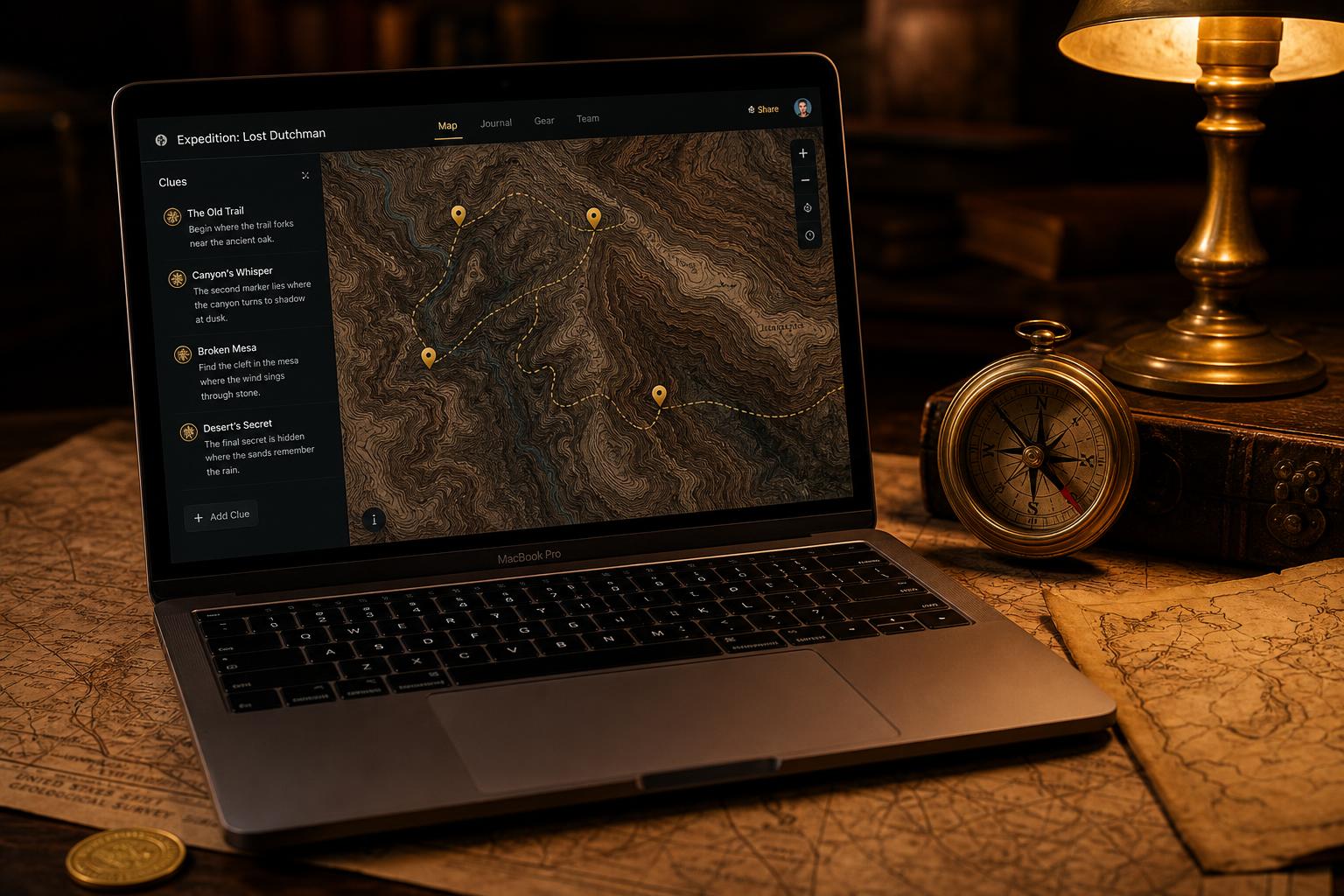
- Drop pins for candidate locations. Even if you have ten candidate sites, getting them on a topo map together usually exposes which ones are obviously wrong.
- Link clues to pins. When a pin's underlying clue collapses, you can see immediately which site is now unsupported.
9. Resources
None of these are affiliated with Jon Collins-Black. They are where the community actively discusses the hunt:
- treasureinside.com — JCB's official site and announcements.
- Mysterious Writings — TTI hub — the most thorough community knowledge base on the hunt.
- Treasure Inside Substack — long-form analyses by Dr. R Squared and others.
- r/treasureinside, r/TheresTreasureInside, r/TreasureInsideHunt.
Last updated: May 2026. Reflects publicly available information from JCB's interviews, his official site, and the active community as of this date. When JCB contradicts this guide, JCB wins.