Beyond the Map's Edge: A Treasure Hunter's Starter Guide
What we know, what hunters are doing wrong, and how to organize a search that actually has a chance.
1. What Beyond the Map's Edge actually is
Beyond the Map's Edge is a real-world treasure hunt launched by author Justin Posey, with a published book of clues guiding hunters to a chest hidden somewhere in the American West. It is the spiritual successor to Forrest Fenn's hunt, with the same magnetic pull on a community of clever, obsessive, often deeply experienced outdoorspeople — and the same potential to draw inexperienced searchers into terrain that doesn't forgive mistakes.
This guide is for the serious hunter. It assumes you've read the book at least twice, that you can name your own working theories, and that you want a system for moving from "I have a hunch" to "I have a defensible search area worth driving to."
2. What's actually been confirmed (as of May 2026)
Build your search on things Posey has actually said in interviews, on his official announcements page, and in the Tucson Seekers Summit Q&A on March 28, 2026. Treat everything else — including confident screenshots from strangers — as theory.
Confirmed:
- The chest is on public land, not private.
- All essential clues are in the poem. The clues are in consecutive order.
- It is not in a dangerous place. Posey at Seekers Summit: "If you need rope, then it's not the right location." He's seen hunters rappelling into caves and onto cliffsides — none of that is required.
- The book's clock-face cipher was solved on April 28, 2026 (answer: MAGYAR). Posey has stated explicitly that it does not point to a location, region, or coordinate. It's a flavor nod to the vessel itself.
- At Seekers Summit, Posey ruled out Colorado and Oregon as the hide state.
- He confirmed that he had searched for the Fenn chest within 75 miles of where he hid his own. Combined with Fenn's "north of Santa Fe" rule, this strongly implies the Northern Rockies corridor — though Posey later softened this and asked hunters not to read it as a hard state-by-state elimination, so treat the southern bound as suggestive, not absolute.
- There is a built-in checkpoint — an intermediate confirmation that you're on the right track before final BOTG. Posey calls it "not something you need to worry about" being moved or blocked.
- Numbers may be indirectly encoded in the poem (homophones, wordplay). There is a distance element to following the clues on the ground.
Punted on (so don't claim either way):
- Whether national parks are ruled in or out.
- Whether you need to move any rocks at the final spot.
- Whether the "hole" in the poem corresponds to a place named "Hole" (e.g., Jackson Hole, Big Hole River).
- Whether the poem must be reordered or rearranged for an optimal solve.
- Whether the cipher lives entirely inside one section of the book, or even in the book at all.
3. The cipher is solved — and fake finds are coming
Two things from Posey's recent announcements deserve their own section, because both of them will eat the next year of careless hunters' time.
The clock-face cipher (MAGYAR) is decorative. Posey's April 28 announcement spells this out: solving it does not bring anyone closer to the treasure — "not a step, not an inch." If a forum thread, video, or DM is selling you a theory that begins "now that we know it's MAGYAR…", the theory is downstream of nothing. Don't anchor on it.
Expect fake finds. Posey has publicly warned that as the hunt matures, staged photos and AI-generated "found it" announcements will appear, because attention rewards the loudest voice in the room regardless of truth. A genuine recovery will be verified through proper channels. Anything you see in an anonymous post, a breathless DM, or a brand-new account deserves the skepticism that kind of source has earned. Do not let a fake find collapse a search area you were patiently working.
4. Organizing your clues
The single biggest difference between hunters who make real progress and hunters who spin in circles for years is how they organize their thinking. The book gives you a finite set of clues, but each clue branches into interpretations, each interpretation suggests a place, and each place demands a verification step. Within a few weeks you have hundreds of fragments and no idea which ones are still load-bearing.
A good system separates three things:
- Clues — the literal text from the book. Immutable. Don't paraphrase.
- Ideas — your interpretations and theories. Tag them, link them to the specific clues they rest on.
- Knowns — facts about the world: elevation of a pass, sunrise on a date, USGS quad name, river mileage. Cite the source.
When an idea collapses (and they will), you can see at a glance which knowns and which clues it was anchored to, and what other ideas you'd have to rebuild. This is exactly the structure Treasure Notes is built around — clues, ideas, and knowns as first-class objects you can link and graph.
5. Reading the topographic clues
The poem-style clues in the book reward people who can translate phrases into landform. A "shoulder" is not a metaphor when you're staring at a 7.5-minute USGS quad — it's a recognizable contour pattern. Same with saddles, benches, draws, spurs, and headwalls.
Spend an evening overlaying your favorite candidate basin in three layers: USGS topo for the contours, satellite imagery for vegetation and water, and OpenTopoMap for shaded relief. Anything that looks compelling on one layer and absurd on another should make you nervous.

6. Image analysis without fooling yourself
Channel splits, inversions, and contrast pushes are real tools. The danger isn't that you use them — it's the one-way ratchet: each adjustment quietly narrows what you'll let yourself see next. Once you've "found the face in the rock," every subsequent filter becomes a way to confirm it, and you lose the ability to notice that it was never there.
A few working rules that keep image analysis honest:
- Always be one click from the raw image. If you can't snap back to the unedited original at any moment, you've stopped doing analysis and started doing art.
- Get a cold second pair of eyes. Show a teammate the edited image with no setup — no "look at the upper left." If they don't see what you see unprompted, you're probably the only one who does.
- Know what each filter actually does. A channel split surfaces real ink, lichen, and shadow that were already in the pixels. It does not add information. If your "find" only appears after stacking five filters, that's the filters talking.
- Treat AI vision the way Posey framed it. At Seekers Summit, he conceded multimodal AI offers a "marginal edge" but won't be decisive. Use it to surface candidates worth a second look. Never use it to certify them.
- Annotate, don't narrate. Mark what you see directly on the image — a box, a circle, a label — so a teammate can disagree with the specific pixel, not the story you've built around it.
7. Planning a safe BOTG trip
Posey's safety guidance has been blunt and consistent: "If you need rope, then it's not the right location." The hunt was deliberately designed so that the final spot does not require technical climbing, rappelling, cave entry, or scrambling cliffs. Read that the right way around — if your candidate solve requires any of those, your solve is almost certainly wrong, not your level of dedication.
BOTG ("boots on the ground") is still where this hunt has cost people their lives in prior incarnations, and the cause has almost always been weather, terrain, and isolation rather than the hide itself. The romantic version is you, a rented Subaru, a vague theory, and a free weekend. The version that comes home is a written trip plan, a partner who has it, and gear matched to the actual conditions of your search area on the actual date.
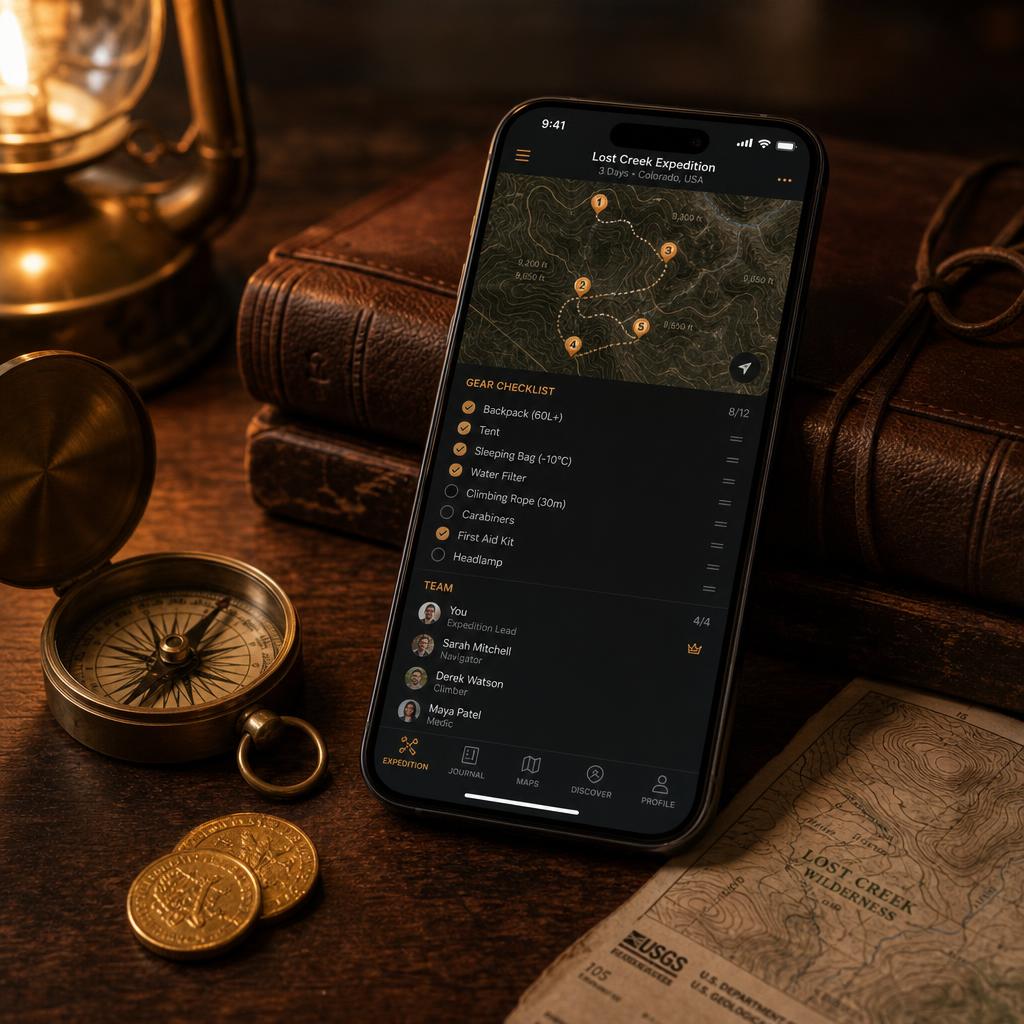
A trip plan worth printing should include:
- Trailhead and parking, with backup if it's full or closed.
- Numbered waypoints with coordinates in two formats (decimal degrees + UTM).
- Weather and snow data for the date window — check a week out and the morning of.
- Gear list versioned per trip, not a generic checklist.
- Team roles, emergency contacts, and turnaround times.
- A printed copy. Cell service drops; paper doesn't.
8. The most common mistakes
- Falling in love with your first solve. Treat your top theory and your second-best theory the same until BOTG eliminates one.
- Anchoring on the cipher or on social-media "leaks." The cipher is officially non-locational. Fake finds are an explicitly anticipated part of this hunt's noise floor — don't let them rewrite a search area you've earned.
- Treating other hunters' theories as evidence. Forums are great for vibes, terrible for facts.
- Going in the wrong season. A "10-minute walk" in July is a snow-bound deathtrap in April.
- Building a solve that requires rope. Posey has told you it's wrong. Believe him before the mountain has to.
- Not writing down what you've already eliminated. You will revisit the same dead end three times if you don't log it.
- Going alone, with no plan, and no one expecting you back. Just don't.
9. Getting started today
If you're starting fresh, here's a 60-minute first session that will outperform months of unstructured research:
- Open a fresh hunt. Type in every clue from the book, verbatim, one per entry.
- Below each clue, add 1–3 ideas you currently hold about what it might mean.
- Add knowns: any verified facts (book confirmations, interview quotes, geographic constraints — including the Colorado/Oregon eliminations and the "no rope" rule).
- Switch to graph view. Look at which clues have zero ideas hanging off them — those are your homework.
- Pick one candidate region and drop three pins on the topo map studio. You're now ahead of 80% of hunters.
That's the entire workflow. The rest is iteration, honesty about which theories survive contact with reality, and the patience to verify before you drive.
Last updated: May 2026. Reflects Justin Posey's announcements through May 2, 2026 and the Tucson Seekers Summit Q&A on March 28, 2026. When Posey contradicts this guide, Posey wins.